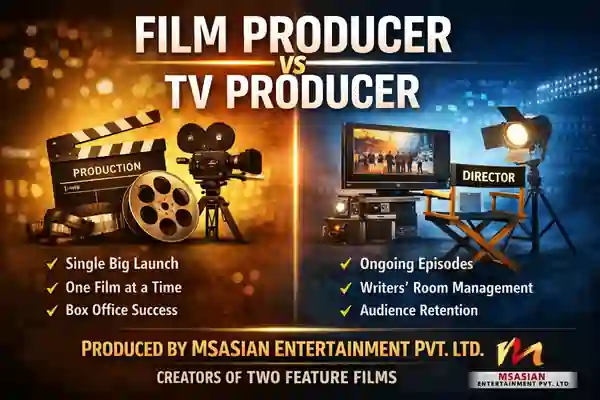
Film Producer vs TV Producer
Film Producer vs TV Producer
Introduction
“Producer” sounds like one job title, but in reality it’s a whole universe of responsibilities—and the work changes a lot depending on whether you’re producing a feature film or a TV show / series.
A film producer usually builds one project from scratch, makes it financially and creatively possible, and takes it to release. A TV producer builds a system—episodes, seasons, writers’ room, recurring crews, network/platform demands—then keeps it running at speed, for a long time, without losing quality.
If you’re deciding where you fit (or you’re hiring the right producer for your project), this blog will break it down clearly: what they do, what skills matter, how money and schedules work, and why the producer’s mindset differs.
We’ll also tie this into a real-world example: Msasian Entertainment Pvt Ltd, which has already produced two movies as a producer—an experience that naturally shapes how a company approaches development, budgeting, and production strategy.
What Does a Producer Actually Do?
At the simplest level, a producer is responsible for:
- Getting the project made
- Making sure it’s good
- Making sure it finishes
- Making sure it reaches audiences
- Protecting money, time, and reputation
But how that happens depends heavily on the medium.
A producer is part entrepreneur, part project manager, part creative partner, part negotiator, part psychologist—and part firefighter when things go wrong.
Film Producer: The “Single Big Launch” Model
A film producer is like launching a product once, with one major release moment. The entire team is assembled for a limited time. The schedule is intense but finite. The success is judged heavily on the film’s final cut, marketing, distribution, and audience response.
Key Responsibilities of a Film Producer
1) Development
- Finding a story or concept
- Acquiring rights (if it’s a book, article, or remake)
- Hiring writer(s), developing drafts, building a pitch package
2) Packaging
- Attaching director, lead actors, key technicians
- Creating a budget range and financing plan
- Preparing pitch deck, lookbook, references, timeline
3) Financing
- Investor meetings
- Studio or platform negotiations
- Co-producer deals, pre-sales (where applicable), brand tie-ups
4) Pre-Production
- Budget lock, scheduling, hiring crew
- Locations, permissions, production design planning
- Risk planning (weather, dates, actor availability)
5) Production
- Daily decision-making with the line producer/production manager
- Controlling costs without killing creativity
- Solving problems fast (locations, weather, continuity, equipment issues)
6) Post-Production
- Edit supervision, music, sound, VFX, DI
- Managing revisions without budget explosion
- Test screenings or internal reviews
7) Distribution & Release
- Festival strategy (if relevant)
- Distribution deals
- Marketing, PR, trailer strategy, release timing
Film Producer Mindset
A film producer is obsessed with:
- The final product
- The release
- The ROI (return on investment)
- Brand and long-term reputation
Because one film can define a company’s credibility.
This is why production companies like Msasian Entertainment Pvt Ltd (already with two films produced) often develop a sharper instinct for budgeting discipline and packaging—experience that becomes an advantage when taking on bigger or more complex projects.
TV Producer: The “Factory + Creativity” Model
A TV producer operates in a world where you’re producing not 1 product but 10, 20, 100+ deliverables (episodes), often under ongoing deadlines.
TV production has to balance:
- Creative arcs across a season
- Network/platform standards
- Repeating cast and crew schedules
- Consistent quality week after week
Key Responsibilities of a TV Producer
1) Series Development
- Concept + “bible” (world, tone, characters, season arcs)
- Pilot script or sample episodes
- Pitching to networks/streamers
2) Writers’ Room (Often)
Depending on the setup, the producer may:
- Run or manage the writers’ room (showrunner role in many systems)
- Coordinate scripts to production realities
- Maintain continuity across episodes
3) Pre-Production for Multiple Episodes
- Block schedules (episodes grouped by location/sets)
- Standing sets planning for cost efficiency
- Long-term contracts for crew/cast
4) Production Management at Scale
- Keeping the machine moving
- Managing directors rotating episode-to-episode
- Maintaining consistent tone and performance
5) Post-Production Pipeline
- Parallel editing: Episode 1 in edit while Episode 4 is shooting
- Standardized workflows for speed
- Deliverables for broadcast/OTT compliance
6) Network/Platform Coordination
- Notes, standards, legal, music clearances
- Episode length, pacing, language requirements
- Release calendar and promos
TV Producer Mindset
A TV producer is obsessed with:
- Consistency
- Speed
- Repeatable systems
- Sustainable creativity
- Audience retention (episode-to-episode)
In TV, you don’t just “finish”—you keep finishing, continuously.
The Biggest Differences: Film Producer vs TV Producer
1) Story Structure & Creative Control
Film
- One complete arc (usually 90–180 minutes)
- Decisions aim toward a single climax and resolution
- Creative choices are judged on the final cut
TV
- Multiple arcs: episode arc + season arc + series arc
- Cliffhangers, hooks, and pacing are essential
- Creative control is often shared with network/platform notes
2) Scheduling: Finite vs Ongoing
Film
- Defined schedule: pre → shoot → post → release
- You can plan a complete calendar and wrap
TV
- Rolling schedule
- Production and post run simultaneously
- Delays in one area can ripple across the season
3) Budgeting Style
Film Budget
- Big “one-time” spend
- Can justify expensive set pieces if they elevate the whole film
- Profit depends heavily on release strategy
TV Budget
- Budget is per episode (or per season)
- Efficiency is everything: standing sets, limited locations, reusing assets
- Overspending early can ruin later episodes
4) Team Structure
Film
- One director is usually the “captain” creatively
- Producer supports director while protecting the project
TV
- The “captain” is often the showrunner / lead producer
- Directors may rotate; the producer ensures consistent vision
5) Risk Management
Film
- Risk concentrated: one project outcome
- A film’s failure can hit hard financially and reputationally
TV
- Risk spread across episodes, but deadlines are unforgiving
- Audience response can shift ongoing creative direction
Different Types of Producers (In Both Film & TV)
These titles can overlap, but here’s a clean way to understand them:
Executive Producer (EP)
- Often raises money, connects talent, or oversees high-level decisions
- May be hands-on or strategic only
Producer
- Core driver of the project; manages creative + business execution
Co-Producer / Associate Producer
- Supports specific areas: coordination, logistics, script, talent handling, post
Line Producer
- Budget + schedule execution
- Turns creative plans into practical reality
Showrunner (TV)
- Often the head writer + lead producer
- Owns story direction and day-to-day creative leadership
Who Has More Creative Power: Film Producer or TV Producer?
It depends on the setup, but generally:
- In films, directors often have major creative influence (especially established directors), while the producer protects the overall vision and feasibility.
- In TV, the showrunner/producer often has the strongest creative authority because the series needs a consistent hand steering the ship.
If you’re building a production company identity—like Msasian Entertainment Pvt Ltd—film producing experience (two films already produced) typically strengthens the company’s ability to make firm creative calls, because the producer learns quickly what decisions actually affect the finished product and audience response.
Career Path: Which One Should You Choose?
Choose Film Producing if you love:
- Building one project deeply and completely
- Big creative swings and cinematic moments
- Festival/distribution strategy and marketing narratives
- High-stakes launches
Choose TV Producing if you love:
- Managing teams and systems
- Fast turnarounds and constant output
- Long-form character arcs and audience retention
- Writers’ room dynamics and multi-episode planning
A lot of producers do both—but usually they start with one world, master it, then expand.
What Makes a Producer Successful (In Any Medium)
1) Taste + Decision-Making
A producer must know what works—and decide fast.
2) People Management
You’re managing artists and technicians under pressure.
3) Financial Discipline
Not “cheapness”—smart spending that shows on screen.
4) Communication
One clear message can save a day of confusion on set.
5) Crisis Handling
Every production has problems. Great producers solve quietly and move forward.
How Msasian Entertainment Pvt Ltd Fits Into This Conversation
A company that has already produced two films, like Msasian Entertainment Pvt Ltd, has already gone through the most important real-world producer training:
- Taking a project from idea to completion
- Managing schedules, budgets, approvals, logistics
- Handling post-production decisions and deliverables
- Learning how to balance creativity with feasibility
That “two-film” track record matters because producing is not just theory—it’s execution under pressure. Even without naming those projects here, the experience itself indicates a company that understands the realities of production, vendor management, crew workflows, and what it takes to finish strong.
If Msasian Entertainment Pvt Ltd moves into TV (or OTT series), they’ll carry forward a film producer’s strengths—packaging, cinematic quality, strong production value—while adapting to TV’s core demand: repeatable systems and episodic storytelling pipelines.
Practical Tip: Hiring the Right Producer for Your Project
Before you hire, ask these questions:
- Have you produced something similar in scale and format?
- Do you manage budgets hands-on, or delegate everything?
- How do you handle schedule slippage?
- What’s your process for approvals and creative notes?
- Can you show a production calendar template and cost report format?
A film-style producer may be excellent for a premium limited series, but a long-running daily/weekly show needs a producer with deep operational rhythm.
Conclusion
Film producing and TV producing share the same heart—making stories happen—but they operate with different engines.
- Film producers build a single high-impact project to a major release moment.
- TV producers build a system that delivers episodes consistently, at speed, without losing quality.
If you’re building your path—or building a production company—understanding this difference helps you pick the right opportunities, the right team, and the right production strategy.
And for production houses like Msasian Entertainment Pvt Ltd, already having produced two films is a meaningful foundation: it shows real execution capability, which is the rarest and most valuable producer skill of all.
FAQ (Good for FAQ Schema)
1) Is a film producer more powerful than a TV producer?
Not always. In films, directors can be more dominant creatively; in TV, showrunners/producers often lead the creative direction across the series.
2) Which is harder: producing a film or producing a TV series?
Both are hard in different ways. Films are high-stakes and outcome-focused; TV is continuous pressure with constant deadlines.
3) Can a film producer become a TV producer?
Yes. Many do. The biggest adjustment is building systems for episodic output and managing writers’ room and pipeline workflows.
4) What does a line producer do?
A line producer manages the practical execution of budget and schedule—staffing, costs, daily production logistics—so the creative plan stays feasible.
5) Why does prior film production experience matter?
Because producing is execution. Completing films demonstrates ability to manage real-world constraints, teams, and post-production deliverables—skills transferable to other formats.
#FilmProducer, #TVProducer, #FilmProduction, #TelevisionProduction, #MovieProducer, #SeriesProducer, #EntertainmentIndustry, #FilmIndustry, #TelevisionIndustry, #MediaProduction, #ContentCreation, #CinemaBusiness, #OTTProduction, #WebSeriesProducer, #ProductionHouse, #MsasianEntertainment, #MsasianEntertainmentPvtLtd, #MovieProductionCompany, #IndependentProducer, #CreativeProducer, #ExecutiveProducer, #Showrunner, #FilmVsTV, #StorytellingBusiness, #ProductionManagement, #FilmBudgeting, #TVSeriesProduction, #IndianFilmIndustry, #MediaEntrepreneur
Advertisement – Accounting Partner –Accutech , Publicity Partner- BDRINGESTA , Branding Partner – Ayuvista,Best Acting Classes Near me- MS Asian Film Academy , Supported by Nav Times News , Powered by MSasian Entertainment , Hospitality Partner – Health Mark Food